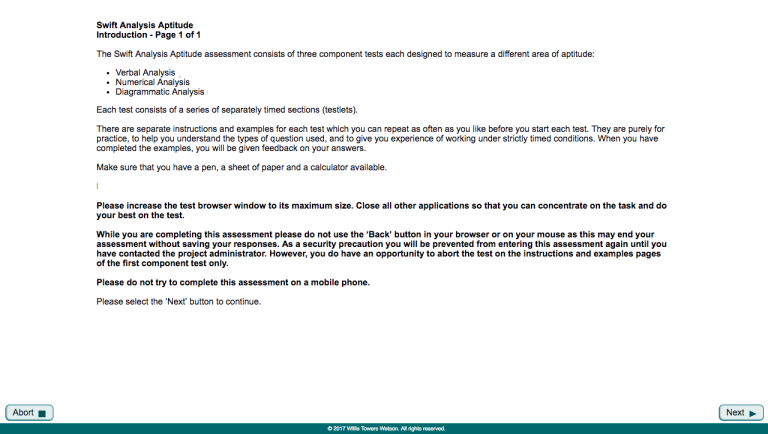
Saville aptitude tests have questions on the numerical, verbal and diagrammatic reasoning components. The test also checks the abstract, error checking and mechanical aspects of the aspirant. On an average it takes 20 minutes to complete the Saville test – they are intended to be extremely time sensitive. It is interesting that Professor Peter Saville (the co-founder of SHL) formed the Saville Assessment Company – thus, there is a slight overlap between the assessments.
The Saville Numerical Reasoning Assessment measures an individual’s ability to interpret, analyze, and work with numerical data effectively. It evaluates skills such as understanding trends, performing calculations, and making logical decisions based on data presented in charts, tables, or graphs. This assessment is particularly suited for roles requiring strong numerical aptitude, such as finance, data analysis, engineering, and management. By identifying a candidate’s capacity to handle numerical information accurately and efficiently, the test helps employers predict job performance and ensure alignment with roles involving quantitative tasks.
The Saville Verbal Reasoning Assessment evaluates an individual’s ability to comprehend, interpret, and analyze written information. It measures skills such as understanding complex texts, drawing logical conclusions, and identifying the accuracy of statements based on provided information. This assessment is commonly used for roles that require strong communication, critical thinking, and decision-making skills, such as management, law, marketing, and administrative positions. By identifying a candidate’s capacity to process and utilize verbal information effectively, the test helps employers predict performance and suitability for roles requiring high levels of verbal aptitude.
The Saville Abstract Reasoning Assessment measures an individual’s ability to identify patterns, relationships, and logical rules within abstract information, such as shapes or sequences. It evaluates problem-solving and critical thinking skills, especially in unfamiliar or complex situations. This assessment is particularly valuable for roles requiring strategic thinking, innovation, and adaptability, such as technical, managerial, and analytical positions. By assessing a candidate’s capacity for abstract reasoning, the test helps employers predict how well individuals can approach new challenges, think creatively, and make logical decisions in dynamic work environments.
The Saville Diagrammatic Reasoning Assessment evaluates an individual’s ability to interpret and analyze flowcharts, diagrams, and process-oriented information. It measures logical reasoning, problem-solving, and the ability to work with complex systems and sequences. This test is particularly relevant for technical, IT, and engineering roles that require understanding and optimizing processes. By assessing how well candidates can recognize patterns, follow logical instructions, and solve process-related problems, the diagrammatic reasoning test helps employers predict performance in roles involving systems thinking and operational planning.
The Saville Error Checking Assessment measures an individual’s attention to detail and ability to identify discrepancies or inaccuracies in data sets. This test evaluates the speed and accuracy with which candidates can detect errors, making it ideal for roles requiring precision, such as data entry, quality control, and administrative tasks. By assessing the ability to work with data quickly and accurately, the error checking assessment helps employers predict job performance in roles where meticulous attention to detail is critical.
Mechanical tests by Saville are assessments designed to evaluate an individual’s mechanical reasoning, spatial awareness, and understanding of physical principles like force, motion, and energy. Often used in recruitment for technical or engineering roles, these tests measure problem-solving skills and the ability to apply mechanical concepts in practical scenarios. They typically involve interpreting diagrams, solving mechanical problems, and understanding tools or systems. Performance on these tests helps employers predict a candidate’s ability to work in mechanically-oriented environments.
The Saville Spatial Reasoning Assessment evaluates an individual’s ability to visualize, manipulate, and interpret three-dimensional objects and patterns. Designed for roles requiring technical aptitude, problem-solving, and spatial awareness, this test measures the capacity to understand and work with spatial relationships, such as rotating or assembling objects mentally. It is particularly relevant for engineering, design, architecture, and other fields where visualizing structures or processes is critical. The assessment helps employers predict job performance by identifying candidates with strong spatial reasoning abilities, ensuring alignment with the demands of technical and design-oriented roles.
The Saville Wave Assessment is a comprehensive psychometric tool designed to evaluate personality traits, workplace behaviors, and motivational drivers, providing a detailed profile of an individual’s potential and fit for professional roles. Integrating personality with competency frameworks, it measures performance predictors across four key domains: Thought, Influence, Adaptability, and Delivery. The assessment offers normative scoring to capture a nuanced view of strengths, risks, and motivations. Available in multiple versions (Professional Styles, Focus Styles, and Strengths), it supports recruitment, leadership development, team building.
The Saville Wave Focus Styles Assessment is a concise 15 minutes version of the Saville Wave designed to evaluate workplace behaviors, motivations, and personality traits in a quick and efficient format. It assesses an individual’s potential across 12 key dimensions within four domains: Thought, Influence, Adaptability, and Delivery. The Focus Styles assessment links these traits to workplace competencies, providing insights into strengths, potential risks, and areas for development. Ideal for recruitment and broader talent management, it is commonly used to identify role fit, predict performance, and guide development in a time-efficient manner while maintaining the scientific rigor of the full Saville Wave framework.
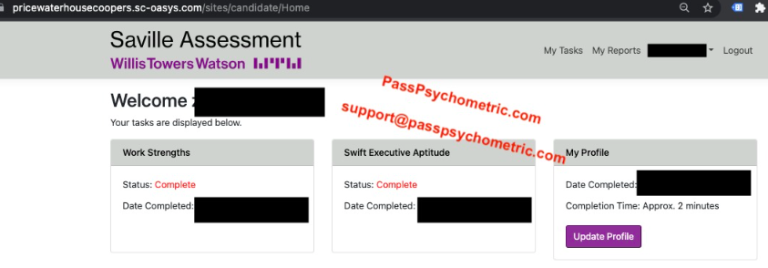
The different assessment topics (mentioned above) can be taken in either single or swift format. In most cases, the swift version is used at an initial recruitment stage in order to sieve out the candidates to progress.
So, how can the PassPsychometric team help? PassPsychometric Experts can help you pass any of your Saville psychometric tests – including the Numerical, Verbal, Diagrammatic reasoning tests and Personality/Work-style test.
To find out more of how the PassPsychometric team can help you pass your Saville psychometric tests with a guarantee in under 24 hours, please click HERE.
The Saville tests are heavily evolved around numerical reasoning, verbal reasoning and logical reasoning abilities – with a greater level of emphasis placed on the Swift Executive Aptitude Test. The formats of the Saville Aptitude Tests are a branch of multiple types: